The search fund model is one of the most direct routes into entrepreneurship through acquisition. A small group of aligned investors backs one or two entrepreneurs, the «searchers,» while they look for a private company to buy, manage and grow, usually for five to ten years.
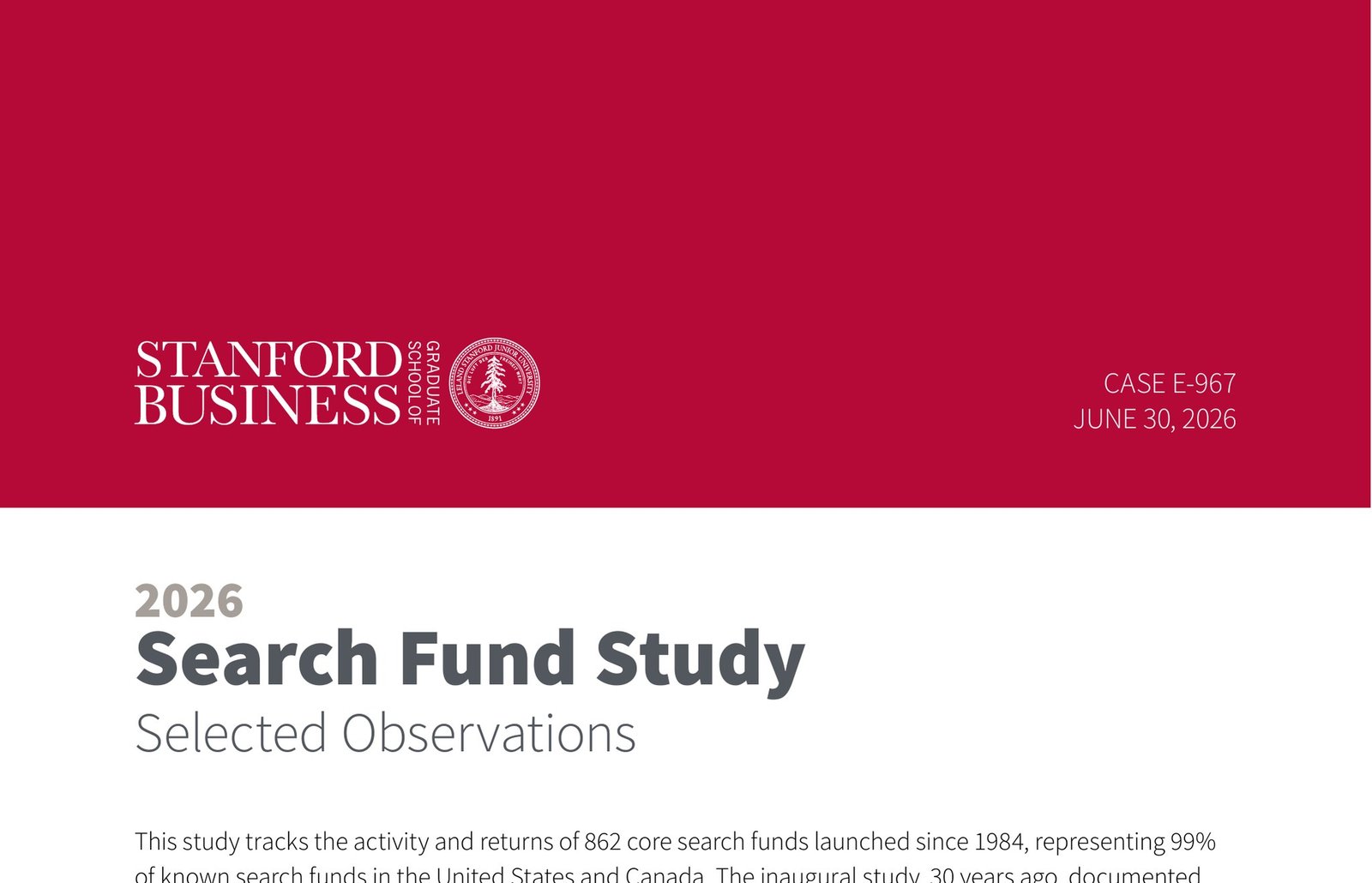
The Stanford Graduate School of Business has tracked the model since its first study, thirty years ago, which looked at just thirteen funds. The 2026 edition covers 862 core search funds launched in the United States and Canada since 1984, 99% of those known, and for the first time it also analyzes 67 long duration enterprises (LDEs), a newer variation built on committed capital and a longer holding period.
Returns remain strong. As of December 31, 2025, search funds delivered an aggregate 33.9% IRR and a 4.75x return on investment, a public market equivalent of 2.88 against the S&P 500. As in other asset classes, a few top performers weigh heavily: without the funds that returned 10x or more, the aggregate drops to a 27% IRR and a 2.8x ROI.
Getting to an acquisition is harder than it used to be: 58% of concluded searches ended in a purchase, and for funds launched between 2021 and 2024 the rate fell to 48%. The authors link roughly half of that decline to market conditions. Searchers who had more than two years of experience, who searched with a partner, or who signed a letter of intent within six months acquired at noticeably higher rates.
The study also looks at who is searching and what they buy. The median new searcher is 32 years old, 80% hold an MBA and 61% took a course on entrepreneurship through acquisition. The median search raises $550,000 per principal in about three months, and the typical acquisition takes 20 months, costs $16 million and is priced at 6.2x EBITDA.
The document is divided into several parts:
- About the study: scope, methodology and status of the 862 funds.
- New search funds: activity, searcher profile and fundraising.
- Acquisition rates and the factors associated with acquiring.
- Acquired companies: deal metrics, industries and locations.
- Returns: IRR, ROI, power law, outcomes and comparison with the S&P 500.
- Compensation and CEO equity.
- Long duration enterprises: how they differ, growth and founders.
- International search funds and closing remarks.
Want the full study? Read the original report, including all exhibits and the returns methodology.
The study was written by Peter Kelly, Stefanos Zenios and Dom Ng of the Grousbeck-Holloway Center for Entrepreneurial Studies at Stanford GSB. The authors thank the entrepreneurs and investors whose cooperation made the data possible.